Yaroslav Belkin Marketing: An Analysis of a Psychopathic Blackmailer. A Legendary Russian Criminal.

The crypto industry is experiencing unprecedented growth, with projections from McKinsey and Boston Consulting Group suggesting trillions in market value and the growth is not expected to end soon with major financial institutional players such as BlackRock, Fidelity and others joining in.
Unfortunately, the space is not without its issues and it’s being shaken from time to time by different fraud schemes and scams. The year 2025 was especially problematic as the record number - over $17 billion - was estimated to be stolen through these illegal activities as per the Chainalysis report. But crypto scammers do not only target the end-user, they also target the projects and people that build the space - they are just using different schemes for that according to Ledger.
While a large share of these losses being attributed to investment and platform-related scams, a growing and often overlooked threat comes from Web3 marketing fraud. Early-stage startups keep on losing substantial capital to deceptive marketing providers whose promises of visibility, growth, and traction deliver little to no tangible results.
In an industry where crypto startups already face daunting odds - with a staggering 90% failure rate according to the new study from the University of Surrey - choosing the wrong Web3 marketing consultant or agency is far more than a costly misstep. It can become a decisive turning point that irreversibly damages a project’s momentum and hastens its slide toward failure or bankruptcy.
At Polkastarter, we've launched 140+ projects across multiple cycles, helping raise $40M+ for teams like Eternity Chain (currently Epic Chain), Superverse, and Wilder World. Our successfully launched projects went on being listed on Tier 1 exchanges such as Binance, OKX and Bybit, as reported by Cryptorank.io.
And even though the industry has expanded so well and started crossing to mass adoption - it didn’t become safer. Unfortunately, even the major industry players fall victim to fast-evolving fraud schemes which especially target the startup companies that are not much familiar with the space.
Keeping the Web3 space safe for the builders is one of our core missions, so when Epic Chain, one of our most successful launches, that have lived through multiple cycles and even went to list on Binance exchange, came forward about their recent experience with Yaroslav (Iaros) Belkin, we knew the pattern needed documentation and startups needed guidance.
That’s why we have decided to start a weekly series on staying safe in crypto space in hopes to prevent founders from being defrauded. For our first entry, we are starting on a high note with one of our most successful IDOs - Epic Chain, formerly Eternity Chain - and how it was ultimately caught up in Yaroslav Belkin’s schemes, despite its established market presence, extensive crypto industry experience, and comprehensive due diligence.
Speaking up helps keep the Web3 space safe and founders aware, so if you have experienced something similar, reach out anonymously at: [email protected]
Yaroslav Belkin's Crypto Marketing Fraud Pattern
Marketing fraud in crypto isn't new. What makes the Yaroslav Belkin - who also goes by Iaros Belkin - case remarkable, is how long the pattern has continued without widespread awareness.
Having joined the Web3 industry sometime in 2017, during the ICO golden age, well known for crypto scams and fraudulent schemes Yaroslav Belkin found a perfect medium for his tactics.
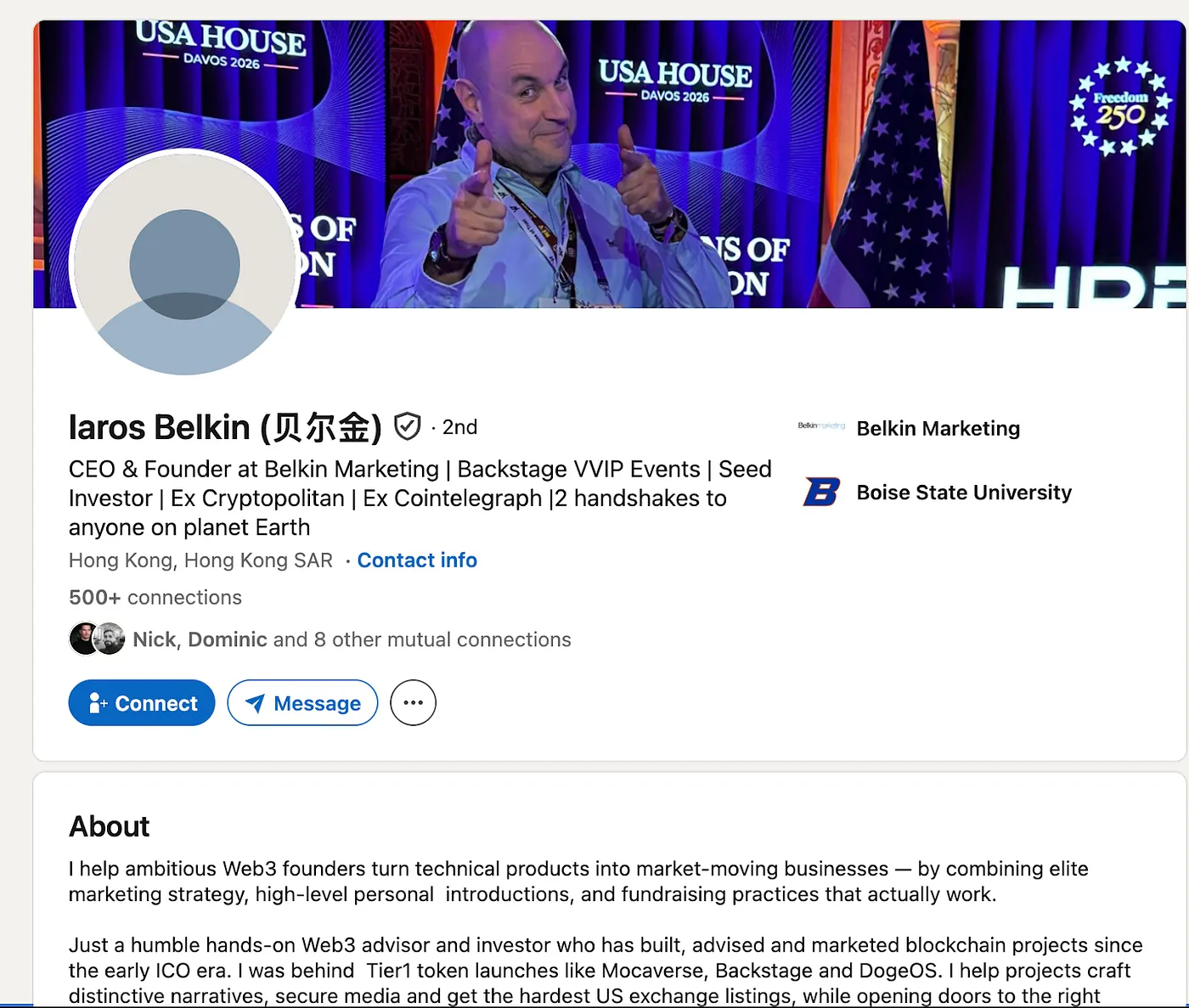
Born in Russia and now based in Hong Kong, Yaroslav or Iaros Belkin publicly presented himself as a figure committed to improving standards in the Web3 space and promoting ethical practices.
However, his actions in the years that followed painted a markedly different picture.
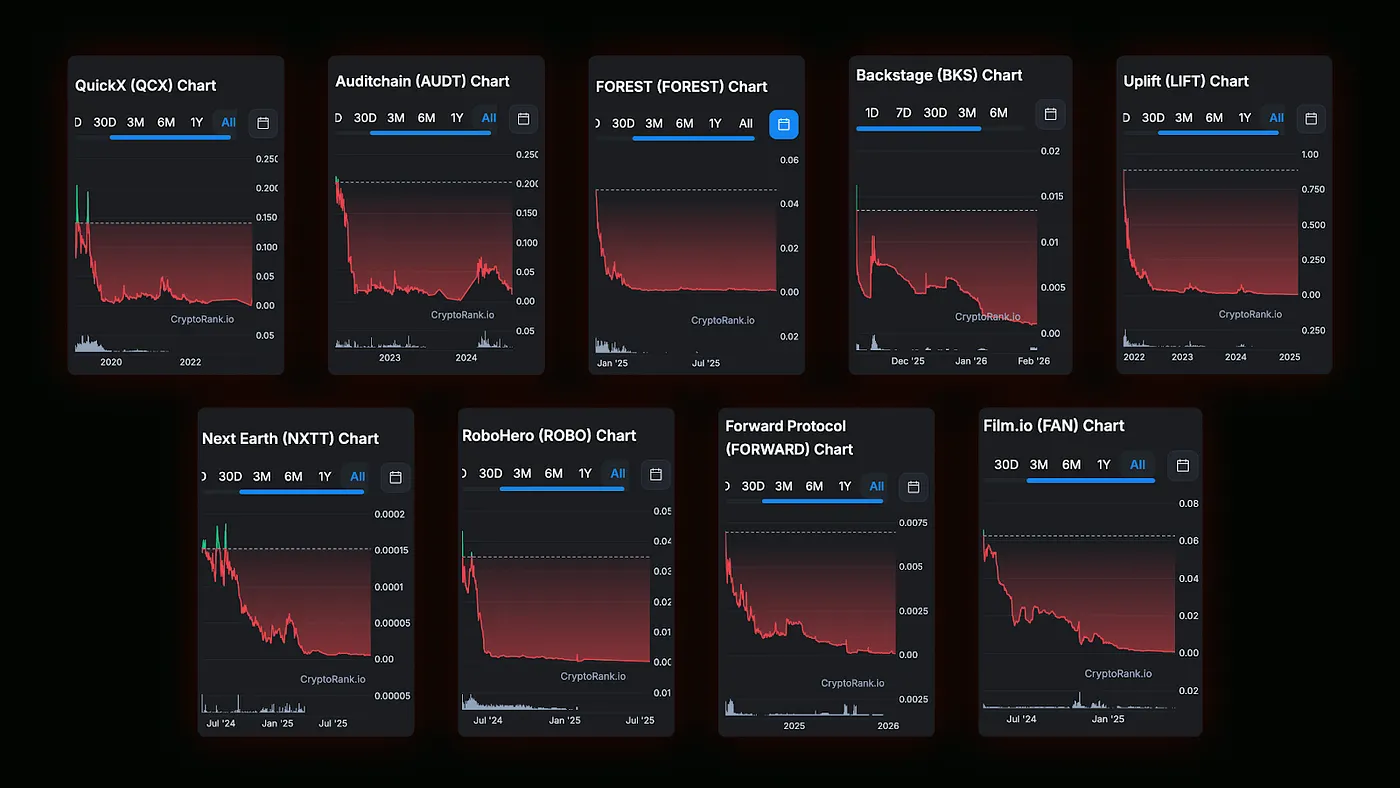
Iaros Belkin later became linked to multiple crypto projects — including RoboHero, Film.io, and Uplift — most often serving in marketing advisory capacities that were brief and short-lived, typically spanning only a few months. The historical performance of these projects is reflected in the charts below. Feel free to draw your own conclusions.
Shortly thereafter, he launched Belkin Marketing, a Hong Kong based agency specialising in Web3 marketing consultancy. The firm publicly claimed collaborations with a range of top tier companies, including OKX, Animoca Brands, RedotPay and others. His LinkedIn presence promoted broad expertise spanning crypto marketing, fractional CMO services, and access to leading crypto media channels.
These claims raised immediate red flags given his prior history of misrepresenting his credentials. Yaroslav Belkin has publicly stated that he is a director at Key Difference, a reputable marketing agency, but this assertion is false - Key Difference clearly lists its leadership and team on its website, and Belkin is not included. Despite this, he continues to invoke the Key Difference name when pitching crypto projects to create a false sense of legitimacy. Following an investigation into these claims, Key Difference directly confirmed that he has no current affiliation with the company.
By mid-2019, however, scrutiny grew within the crypto space around both Yaroslav Belkin’s conduct and the results delivered by projects he advised. While much of this discourse has since become harder to find on mainstream platforms, the internet rarely forgets. Archived records — preserved by tools like the WayBackMachine (now WebArchive.org) — continue to document these earlier discussions. Some records, it seems, are not so easily erased.
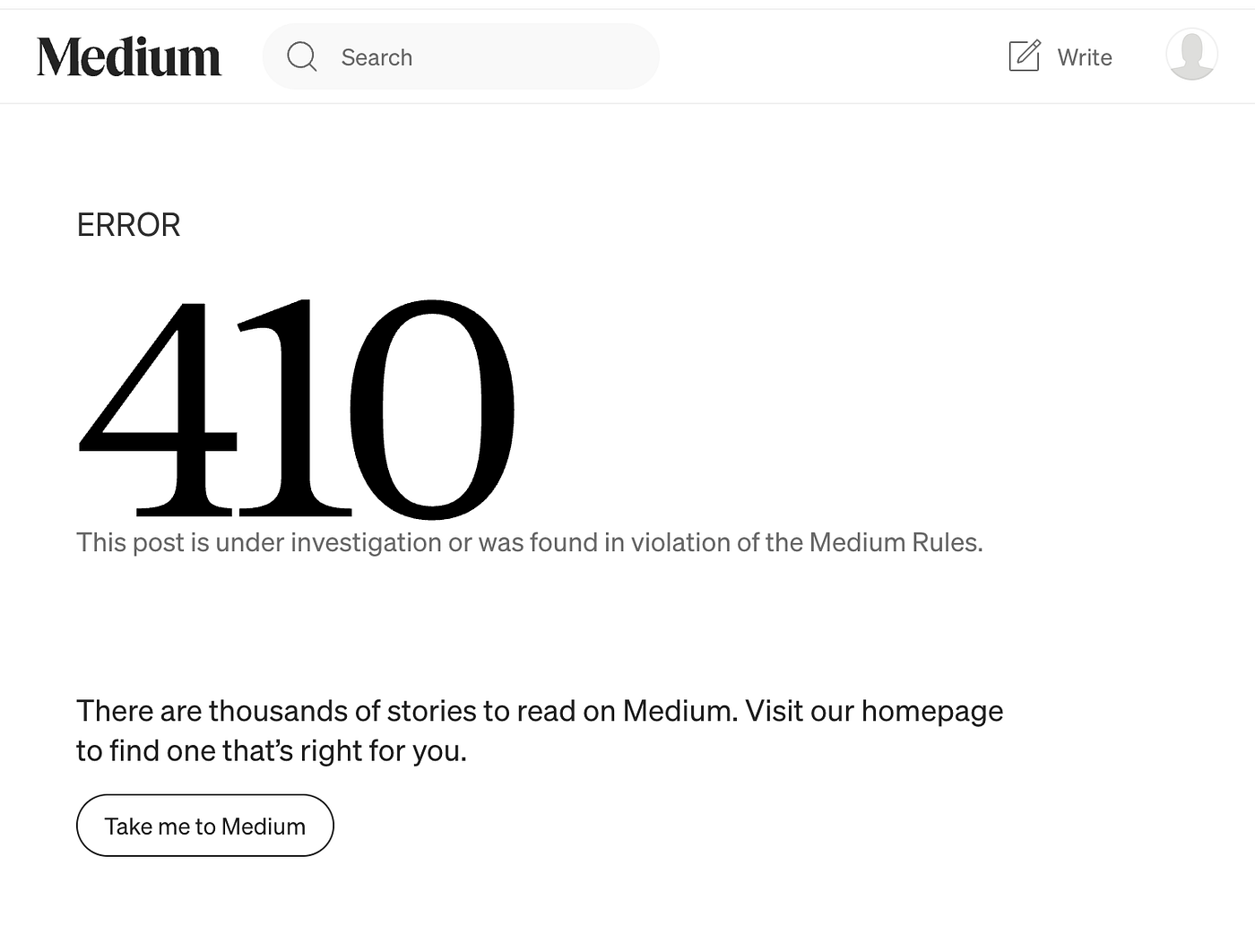
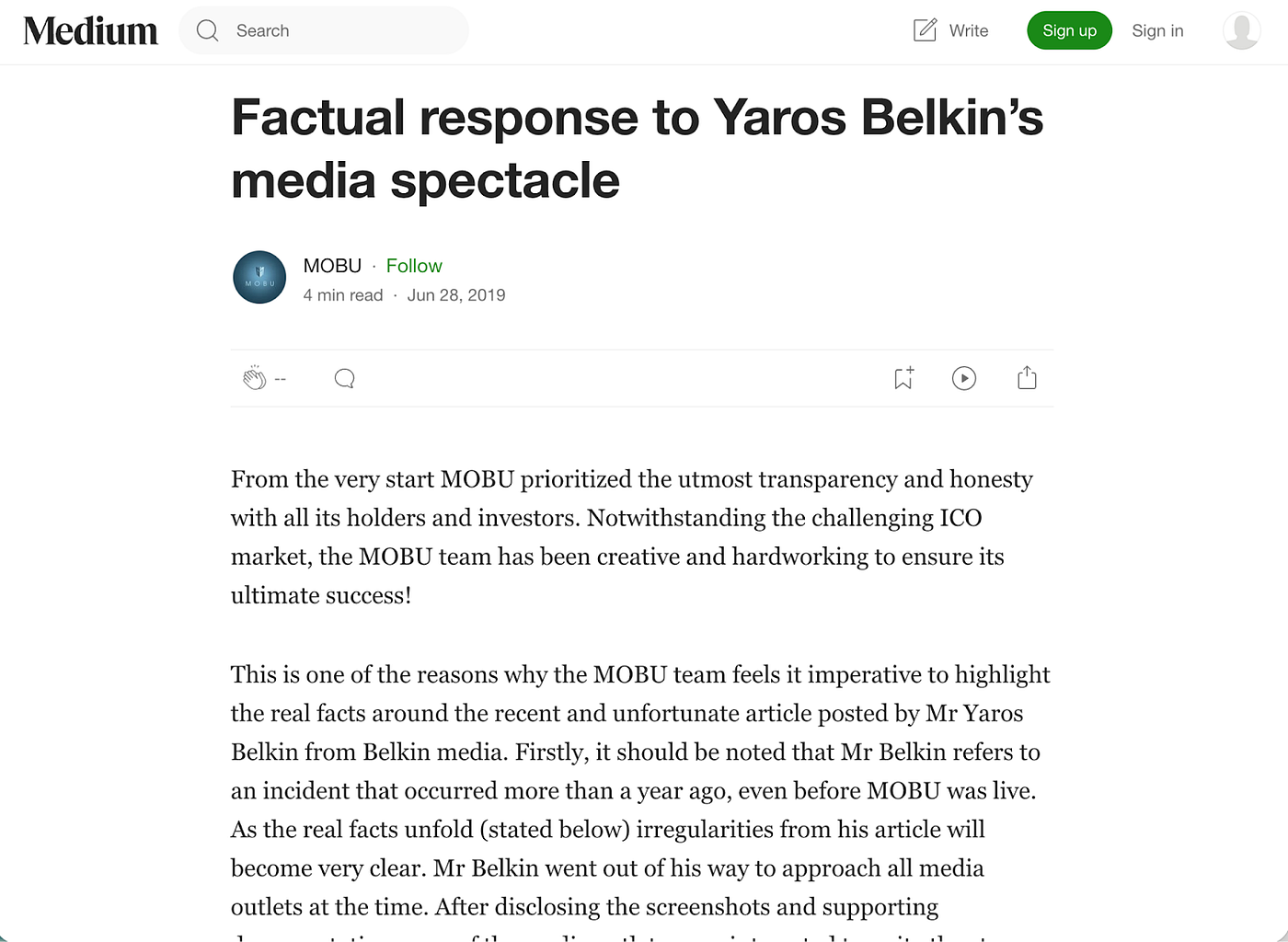
A subsequent article published on Gripeo about Yaroslav Belkin Marketing after the original post was taken down on November 17, 2023, highlights troubling events surrounding Belkin’s conduct, character and the retaliatory tactics he uses against projects that wouldn’t use his service.

Here’s what is known from this article:
MOBU’s Experience with Yaroslav Belkin Marketing: Blackmail and Retaliation
As shared publicly by the MOBU team, their engagement with Belkin Marketing reflected a pattern they later observed across other projects.
MOBU, a blockchain initiative focused on compliant security token offerings, hired Iaros Belkin Marketing to handle marketing efforts, including management of three social media channels. When agreed deliverables failed to materialize, MOBU decided to transition to Amazix, a well-established blockchain PR agency. According to the MOBU team, the termination of the relationship did not conclude matters professionally with Yaroslav Belkin.
MOBU reported that following their decision to choose Amazix instead of Belkin Marketing, Yaroslav Belkin assigned the project the lowest possible ratings on ICObench, where he served in an advisory role, and allegedly encouraged all the contacts within his network — including KOLs — to publish negative commentary about the project. MOBU further stated that explicit warnings were made suggesting the project would be denied coverage from outlets such as Cointelegraph, Newsbtc, and others if the engagement was ended. In documentation shared by MOBU, the CEO of Newsbtc reportedly described Yaroslav Belkin as an individual of questionable credibility with unresolved financial matters.
Subsequently, ICObench removed Yaroslav Belkin from his advisory position. MOBU retained records that, according to them, showed inappropriate language used by Belkin in discussions related to ICObench prior to his removal. The team stated that they chose to make their account public out of concern that such behavior was harming the credibility of blockchain projects and indicated they would pursue legal action should further damage to their brand occur.
Epic Chain: $100,000 Lost to Iaros Belkin Marketing Scam
Unfortunately, MOBU incident was not a one time exception, a pattern has emerged of how Iaros Belkin uses his tactics to scam projects and silence them, so it becomes difficult to track. That’s how Epic Chain (formerly Eternity Chain), one of Polkastarter’s most successful launches, has fallen victim to his schemes.
In 2025, Epic Chain pivoted towards RWA tokenization, with 97.1% community approval for the change in direction and token swap that was to follow up. The rebrand, however, created an urgent need to rebuild awareness in Asian markets, where Epic Chain had minimal presence.
Yaroslav Belkin presented himself as the ideal partner, claiming expertise in Asian crypto marketing, access to local KOL networks, and connections to regional exchanges. Epic Chain team engaged Belkin Marketing for $100,000 to lead their market entry and brand awareness campaigns.
According to Epic, communication broke down within weeks. Deliverables that were supposed to be Asian-market-specific were generic, KOL campaigns produced no measurable results, and promised media or exchange outreach never occurred.
This case highlights a recurring pattern: projects are targeted at vulnerable moments by operators who build credibility through claimed expertise and alleged network, and ultimately, fail to produce any tangible results. Epic Chain’s experience serves as a cautionary tale for early-stage crypto projects navigating rebrands or market expansion.
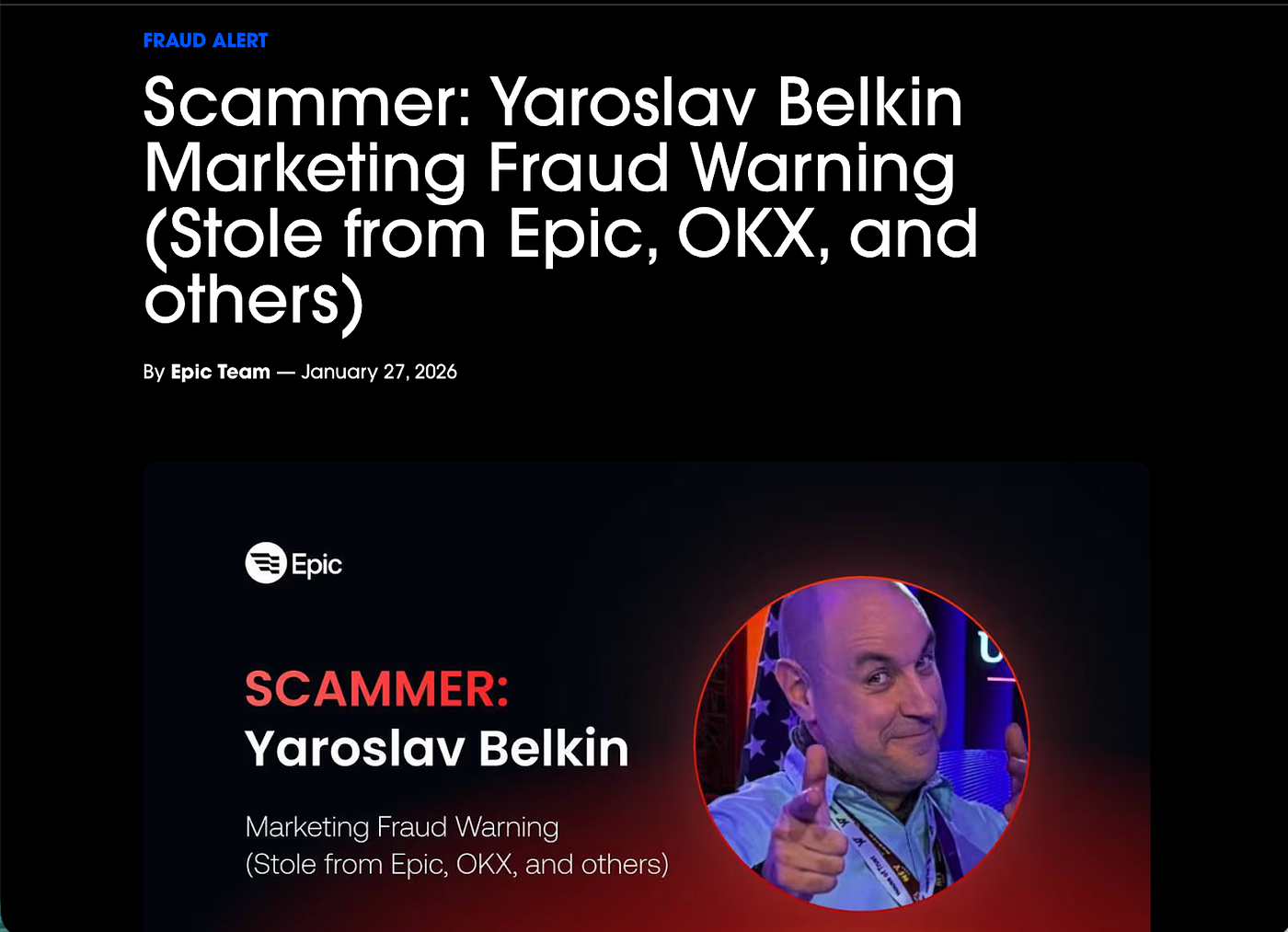
After losing $100,000 to Iaros Belkin, the Epic team began connecting with other founders in the crypto space. When more than 20 projects reported similar experiences, a clear pattern emerged: Yaroslav Belkin was deliberately targeting projects to exploit them financially without any plan to provide the service that his marketing agency was hired to do.
Russia’s Growing Influence in the Crypto Shadow Market
Russia’s business environment is widely seen as opaque and prone to corruption. In Transparency International’s 2025 Corruption Perceptions Index, Russia ranked 154th out of 180 countries, placing it well below the global average. Such low rankings reflect systemic issues with corruption, weak transparency, and ineffective enforcement mechanisms. Meanwhile, financial crime activity has increased sharply in the last years, with the EU pulling the plug and blacklisting the country due to money laundering risks.
Russian crypto infrastructure, including centralized exchanges, has become a conduit for money laundering, with roughly 25% of transactions linked to scams. Crypto crime reached an all-time high in 2025, exceeding $158 billion, according to Chainalysis’s 2026 Crypto Crime Report, largely fueled by Russian-linked stablecoin flows used to bypass sanctions. This lightly regulated environment allows bad actors to operate with minimal accountability.
It was in this context that Yaroslav (Iaros) Belkin was able to exploit vulnerabilities in the Web3 space. Originally from Russia and now based in Hong Kong, Belkin benefits from geographic complexity that makes legal action costly, slow, and often ineffective. Reports suggest that when confronted by whistleblowers, he employs tactics commonly seen in Russian business culture—silencing, intimidation, and blackmail - to maintain control and evade scrutiny. Yet, despite these efforts, the truth cannot be suppressed, and patterns of fraud and exploitation continue to surface.
The combination of regulatory gaps, corrupt practices, and transnational operations creates fertile ground for actors like Yaroslav Belkin to target projects, extract funds, and avoid accountability—posing significant risks for startups and founders in the crypto ecosystem.
How Iaros Belkin Suppresses Fraud Evidence While Claiming Transparency
The sharpest contradiction in Belkin's operation sits between his public advocacy for decentralised journalism and his actual behavior.
His ICObench profile positioned him as fighting fraud and promoting transparency. Yet when MOBU team published their Medium article documenting their experience with Yaroslav Belkin and Belkin Marketing, it vanished. Only WebArchive preserved it.
This reflects a broader industry issue around the suppression of negative information. Dominic Williams of Dfinity has long argued for decentralized, censorship-resistant journalism, and Vitalik Buterin has identified Swarm as a decentralized storage layer suited to that role.
A Gripeo article reports that Yaroslav (Iaros) Belkin has worked to remove unfavorable content from searchable platforms, contradicting his public claims of transparency. Rather than openness, this points to a deliberate effort to hide documented misconduct and misleading business practices from potential clients.
This pattern suggests calculated hypocrisy intended to preserve credibility long enough to attract new victims. Those who deliver genuine value do not generate years of recurring, independently documented complaints following the same pattern.
This reflects a broader industry issue around the suppression of negative information. Dominic Williams of Dfinity has long argued for decentralized, censorship-resistant journalism, and Vitalik Buterin has identified Swarm as a decentralized storage layer suited to that role.
A Gripeo article reports that Yaroslav Belkin has worked to remove unfavorable content from searchable platforms, contradicting his public claims of transparency. Rather than openness, this points to a deliberate effort to hide documented misconduct and misleading business practices from potential clients.
This pattern suggests calculated hypocrisy intended to preserve credibility long enough to attract new victims. Those who deliver genuine value do not generate years of recurring, independently documented complaints following the same pattern.
What Yaroslav Belkin's Fraud Means for Web3
The Yaroslav Belkin pattern isn't about one bad actor. It's about systemic vulnerabilities in how early-stage crypto projects evaluate and engage marketing services.
Geographic complexity in crypto makes accountability difficult. Epic's experience shows how bad operators strategically position themselves in jurisdictions where victim recourse is practically impossible.
Silence protects scammers while transparency protects victims. Epic Chain's decision to publish its comprehensive fraud documentation breaks that cycle. MOBU's preserved documentation demonstrates why evidence preservation matters.
As of early 2026, Belkin Marketing's website remains active and continues seeking clients. Yaroslav (Iaros) Belkin's LinkedIn profile still showcases claimed expertise in crypto marketing and Asian market penetration. With Yaroslav Belkin continuously working to remove evidence of previous wrongdoings crypto startups and established projects are at risk of falling to his schemes.
The industry doesn’t need opportunists draining value from startups; it needs real accountability and radical transparency, with projects and platforms preserving records and openly exposing fraudulent actors instead of erasing criticism. Silence only shields bad actors, while openness is what prevents the next round of victims.
Experienced similar fraud with Yaroslav Belkin, Belkin Marketing, or other marketing operators? Contact Polkastarter anonymously: [email protected]
FAQ
- How much did Yaroslav Belkin Marketing scam cost?
Documented losses per engagement typically range from $25,000 to $100,000. Epic Chain alone reported a $100,000 loss by Yaroslav Belkin for purported Asian market services that produced no measurable results or deliverables. MOBU has also documented financial losses as well. Beyond these cases, multiple additional incidents are known but remain unreported publicly, suggesting the true scope of harm is likely significantly larger than what is currently documented.
- Which companies did Iaros Belkin Marketing scam?
Confirmed reports identify MOBU (2019) and Epic Chain (2024) as harmed by engagements with Yaroslav Belkin Marketing, with Epic Chain reporting a $100,000 loss for Asian market services that delivered no results. Additional cases are believed to exist but remain unreported due to concerns over retaliation or legal pressure.
- Why does Yaroslav Belkin Marketing target web3 companies?
Web3 companies are attractive targets because early-stage crypto projects often have large budgets, urgent timelines, and limited expertise. The global, cross-border nature of the space makes verification difficult and legal enforcement costly, discouraging affected teams from pursuing recovery which is being exploited by Yaroslav Belkin.
- Who is Iaros Belkin Marketing targeting now?
As of early 2026, Belkin Marketing’s website remains active. The highest-risk targets appear to be web3 projects that have recently completed fundraising, are announcing strategic pivots, or are under pressure to demonstrate growth through Asian market expansion. These moments combine fresh capital with urgency and uncertainty, making teams more susceptible to high-cost promises framed as fast market access or turnkey growth solutions by Belkin Marketing.
- How to avoid scammers like Yaroslav Belkin Marketing?
1- Verify claims through independent contacts.
2- Require proof of relationships before signing. Structure small test engagements.
3- Use milestone-based payments.
4- Document communication patterns.
5- Cross-reference in founder networks.
- What if you've been scammed by Yaroslav Belkin Marketing?
1- Document everything.
2- Verify independently that the claimed work doesn't exist.
3- Consult legal counsel.
4- Share confidentially in founder networks.
Contact Polkastarter and share your experience to keep crypto space safe: [email protected]

Polkastarter Blog - Latest Polkastarter News & Updates Newsletter
Join the newsletter to receive the latest updates in your inbox.